
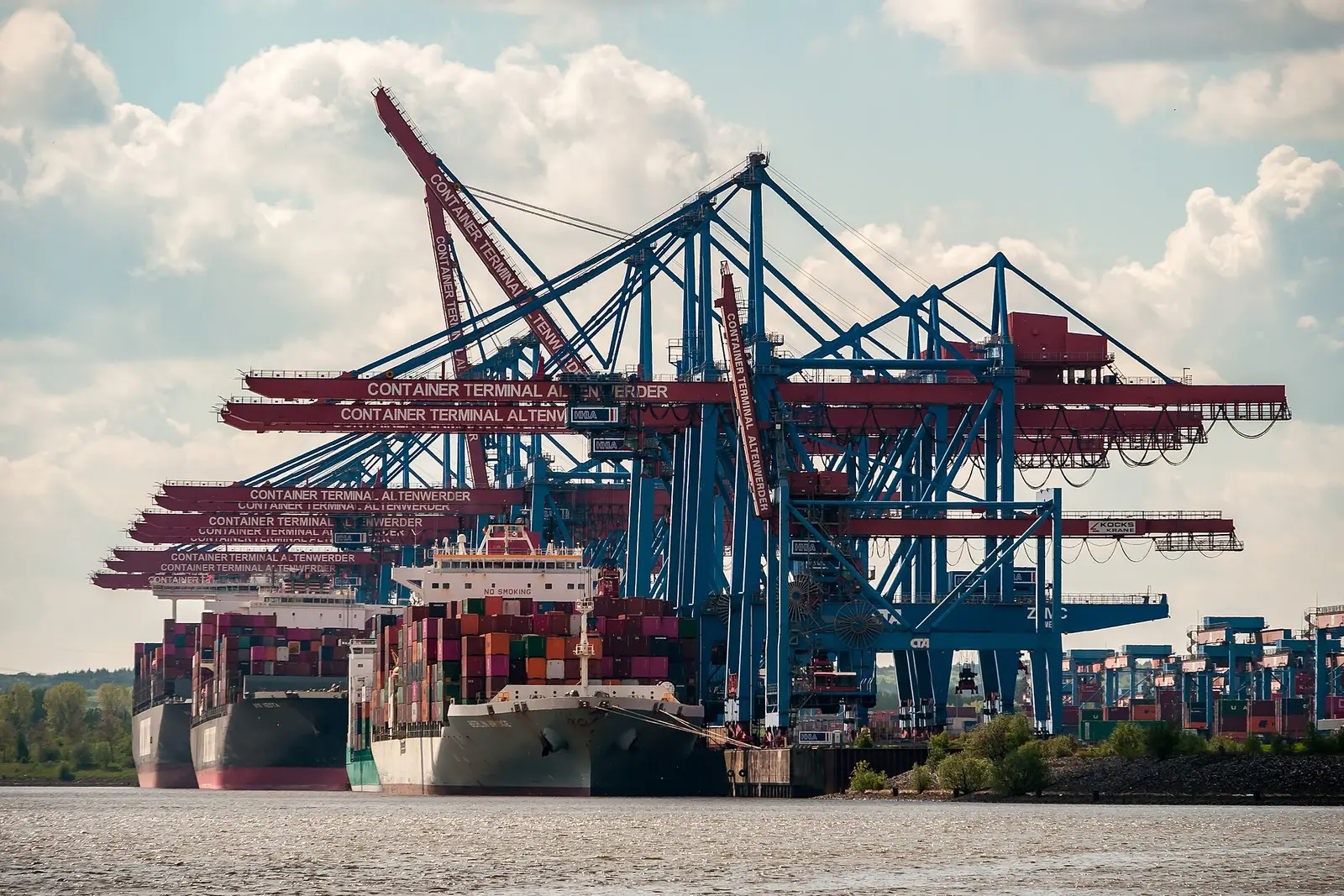

A container ship travelling from Shanghai to Rotterdam through the Suez Canal covers about 10,500 nautical miles. Around the southern tip of Africa the journey is roughly 13,800 miles, about 3,200 more. That difference is the starting point for understanding how a local security problem becomes a global cost.
The arithmetic of distance
Shipping capacity is not just the number of ships; it is the number of voyages those ships can complete. The longer route adds something like one to two weeks each way, depending on speed. If every round trip takes that much longer, the same fleet delivers fewer containers per year. Carriers need more vessels to keep a weekly service running, and when spare vessels are scarce, the price of space rises.
This is why freight rates can jump even when the quantity of goods being shipped has not changed at all. The disruption shrinks supply.
The chokepoints
A handful of passages matter most:
- The Suez Canal and Red Sea, the short route between Asia and Europe.
- The Panama Canal, linking the Atlantic and Pacific, which depends on fresh water and is therefore vulnerable to drought.
- The Strait of Malacca, past Singapore, between the Indian and Pacific oceans.
- The Strait of Hormuz, the exit from the Gulf, discussed in our explainer on the 2026 disruption.
Hub ports sit beside them. Singapore and Rotterdam in the Netherlands thrive because cargo is transferred between ships there. Jebel Ali in the UAE plays the same role for the Gulf, but it lies inside the Strait of Hormuz, so its position is an advantage only while that strait is open.
A disruption that did not go away
When attacks on ships in the Red Sea began in late 2023, many expected a short interruption. Instead, Suez traffic roughly halved in 2024 and stayed low through 2025. Carriers reorganised their networks around the longer route; Hapag-Lloyd, one of the largest container lines, described the timing of any return as unclear in its 2025 annual report. Some services began moving back during 2026, but only partly.
Panama followed a different path. Drought in 2023–24 forced the canal authority to cut the number of ships it could handle each day; traffic has since recovered, with 13,951 transits in its 2026 fiscal year.
The lesson is that “temporary” can mean years, and that several chokepoints can be impaired at the same time.
From freight rates to shop prices
It is easy to overstate the link between shipping costs and inflation. For most manufactured goods, ocean freight is a small part of the final price; a container holds thousands of items. Importers also buy much of their shipping on annual contracts, which change more slowly than headline spot rates.
Where the effect is clearer is in timing. Longer journeys delay deliveries, and manufacturers that rely on parts arriving just in time, such as carmakers, may have to slow production or pay for air freight. Companies may respond by holding more inventory, which ties up cash.
What changes, and what does not
The industry adapts. Schedules are redrawn and new ships, ordered when rates were high, enter service; periods of very high freight rates have often been followed by too much capacity. How that plays out this time depends on when routes reopen, which nobody can date.
What persists is a shift in how companies think about risk. Decisions about where to source and how much stock to hold now give more weight to the reliability of routes, not only their cost. That is a slower, quieter effect than a spike in a freight index, and it is harder to measure.