
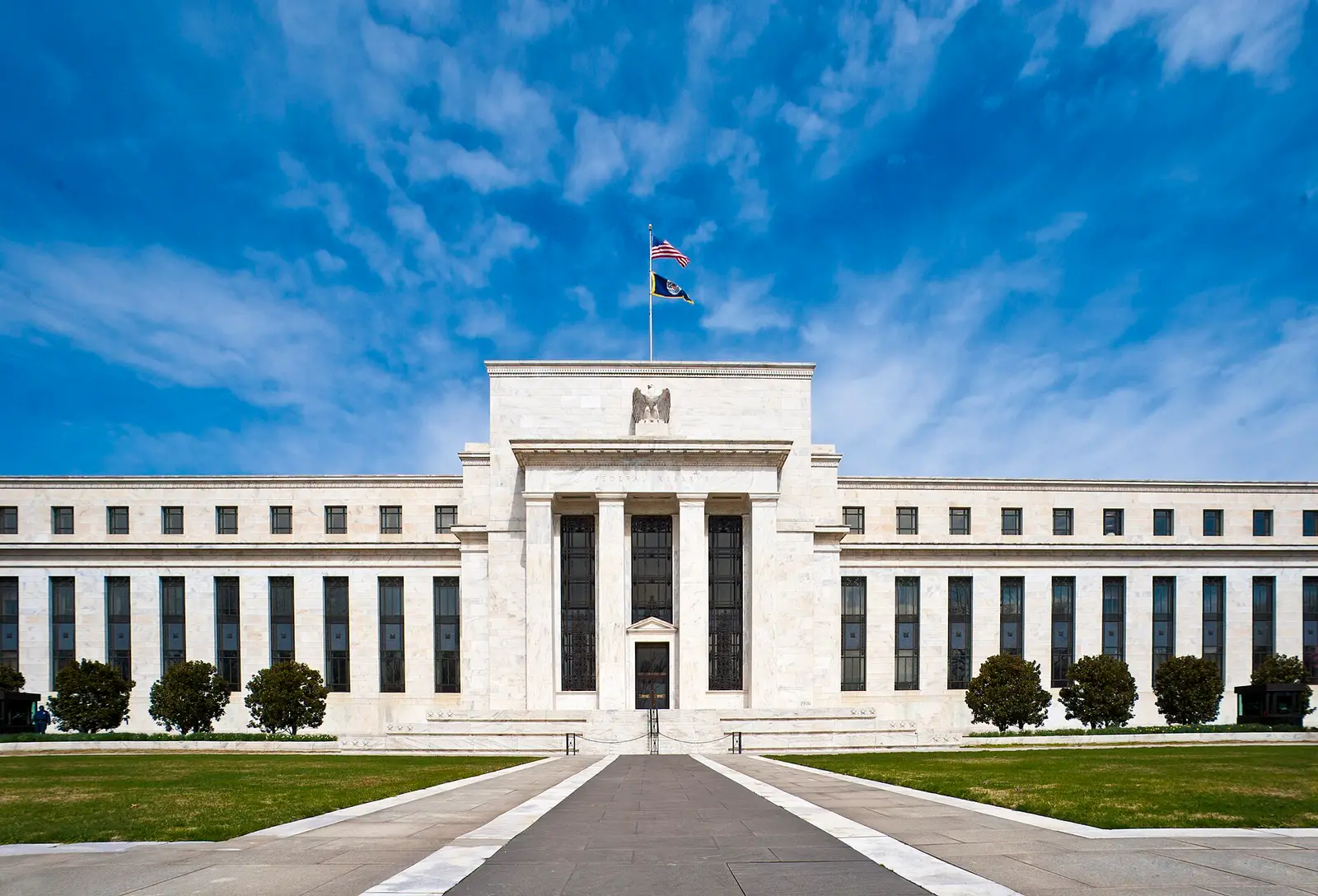

Eight times a year in Washington, and about as often in Frankfurt, a committee decides the price of overnight money. The decision is usually a quarter of a percentage point or nothing at all. Yet it ripples through almost every financial price.
The past two years offer a clear illustration. Through 2025 both the Federal Reserve and the European Central Bank were cutting rates as inflation eased. In 2026 an energy shock sent inflation back up, and both reversed course.
Step one: the overnight rate
A central bank controls the interest rate on very short-term lending between banks. In the United States the benchmark is the federal funds rate; you can see what the market actually pays each day in the effective federal funds rate. In the euro area the anchor is the ECB deposit facility rate.
Other short-term rates, such as SOFR, which replaced LIBOR as the reference for dollar loans and derivatives, sit close to these policy rates.
Step two: bonds
A government bond is a promise of fixed payments. When new bonds offer higher interest, existing ones paying less become less attractive, so their prices fall and their yields rise. Two-year yields mostly reflect where investors expect the policy rate to be over the next two years. Ten-year yields add views about long-run growth, inflation and the compensation investors demand for uncertainty.
This is why bond prices often move before the central bank does: they respond to changes in expectations. A meeting at which rates are left unchanged can still move markets if the accompanying statement shifts the outlook.
Step three: currencies
Money tends to flow towards higher returns. If US rates rise relative to euro-area rates, holding dollars becomes more rewarding and the dollar tends to strengthen against the euro. The EUR/USD reference rate is the most direct place to see the two central banks’ policies meet.
For economies that peg their currencies to the dollar, the link is tighter still, as explained in why Gulf interest rates follow the Federal Reserve. Japan shows the opposite case: years of very low rates left the yen sensitive to every change in the gap with rates abroad.
Step four: shares
Share prices reflect expected future profits, discounted back to today. A higher interest rate reduces the present value of profits far in the future, which tends to weigh most on fast-growing companies. Higher rates also raise companies’ borrowing costs, which matters more when firms are borrowing heavily to invest, as the largest technology companies now are for AI infrastructure.
But context matters. If rates are rising because the economy is strong, profits may be rising too. The same rate increase can accompany a rising or a falling stock market.
Step five: banks and borrowers
Banks sit in the middle. They earn the difference between what they charge borrowers and what they pay depositors. When policy rates rise, loan rates often adjust faster than deposit rates, widening that margin. JPMorgan Chase, the largest US bank, earned more than half of its 2025 revenue from net interest income, and lenders such as DBS describe their earnings as sensitive to interest rates. Over time, though, higher rates can slow lending and increase defaults.
Households and businesses feel the change through mortgages, loans and savings rates. That final step, from financial markets to spending and prices, is how monetary policy is meant to influence inflation, and it is the slowest and least predictable link in the chain.
Why 2026 is a hard case
Central banks usually raise rates to cool an economy in which demand is running ahead of supply. The 2026 rise in inflation began differently, with a disruption to oil and gas supply. Higher interest rates cannot produce more energy. What they can do is stop a one-off jump in prices from feeding into wages and other prices and becoming persistent.
Whether that is happening is a judgement, which is why the split votes on recent decisions are worth noticing. In the United States, core inflation, which strips out food and energy, was 2.6% in September 2026, well below the 3.7% headline rate. How a central bank weighs those two numbers says a good deal about what it will do next.