
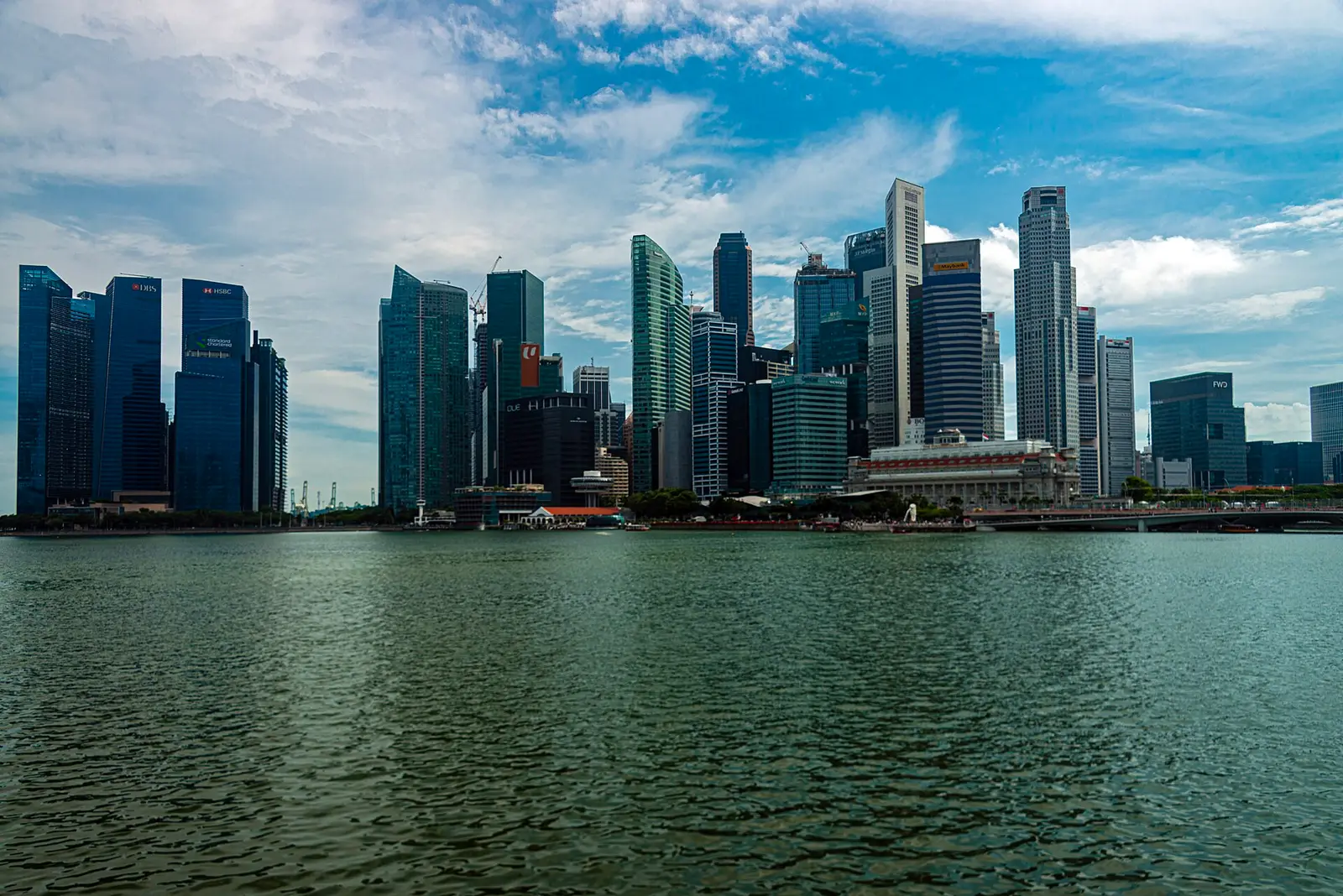

Singapore manages money for a large part of Asia. Its fund managers, private banks and family offices oversee trillions of dollars, and most of that money comes from elsewhere.
This analysis looks at the size of that business, the three local banks at its centre, the unusual way the central bank runs monetary policy, and the regulatory shock of 2023.
The size of the hub
The Monetary Authority of Singapore (MAS), which is both central bank and financial regulator, surveys the industry each year. Its 2025 survey, published in 2026, reports:
| Measure | End-2025 |
|---|---|
| Assets under management | S$6.68 trillion, up 10% |
| Net new money in 2025 | S$376 billion, up 29% |
| Share sourced from outside Singapore | 76% |
| Share invested outside Singapore | 88% |
| Licensed fund management companies | 1,320 |
The largest single source is the rest of Asia-Pacific, at 39% of assets. The two ratios at the bottom of the table describe the business model: Singapore is a booking and management centre for foreign wealth, invested mostly in foreign markets. Its own stock market, the Straits Times Index, is a small part of the picture.
Alternative assets were the weak spot, growing only 0.4%. MAS attributes that to one large manager shrinking; excluding it, growth was 9%.
Family offices
A distinctive part of the hub is the single family office: a private firm that manages one wealthy family’s money. Singapore offers tax incentives to those that meet conditions set by MAS, which it revised in 2026.
MAS told Parliament in August 2026 that more than 2,000 single family offices were receiving these incentives at the end of 2025, serving families mainly from Asia-Pacific, followed by Europe and the Americas. It did not give their combined assets.
Three banks at the centre
Singapore’s banking system has many foreign banks, but at its centre are three locally headquartered groups: DBS, OCBC and UOB. Their 2025 results, from their own releases:
| DBS | OCBC | UOB | |
|---|---|---|---|
| Net profit 2025 | S$11.0bn (down 3%) | S$7.42bn (down 2%) | S$4.7bn (down 23%) |
| Net interest income | S$14.5bn (slightly up) | S$9.15bn (down 6%) | S$9.4bn (down 3%) |
| Net interest margin | 2.01% (down 0.12 points) | not stated | 1.89% (down 0.14 points) |
| Wealth assets | S$488bn | S$343bn | S$201bn |
The wealth figures are each bank’s own measure and are not directly comparable. DBS also attributed part of its fall in net profit to the 15% global minimum tax; UOB’s larger drop came mainly from setting aside provisions against possible future losses.
The common thread is the net interest margin: the gap between what a bank earns on loans and securities and what it pays depositors. All three said lower benchmark rates had narrowed it.
How interest rates feed bank profits
The general mechanism is this. Some deposits pay little or nothing, while many loans are priced off a floating benchmark, the Singapore Overnight Rate Average (Sora). When Sora rises, loan income rises faster than deposit costs and margins widen. When it falls, the reverse happens. OCBC described 2025 in exactly those terms: asset yields fell faster than funding costs.
DBS’s chief executive, Tan Su Shan, noted in November 2026 that average Sora had roughly halved from a year earlier. DBS kept net interest income broadly stable through hedging (locking in rates in advance) and by growing its balance sheet, but its margin was 1.87% in the third quarter of 2026, nine basis points lower than a year before.
The banks’ answer has been fees. DBS’s wealth-management fees rose 29% in 2025 and another 24% in the first nine months of 2026; OCBC’s wealth income reached 38% of its total. This is the link between the hub and the banks: wealth clients bring fee income that does not depend on the level of rates. It does depend on markets, though. DBS’s third-quarter 2026 profit fell 5% largely because trading income dropped.
A central bank that steers the currency
The question is what sets Sora, and the answer is mostly not MAS. Unlike most central banks, MAS does not set an interest rate. It manages the Singapore dollar against a trade-weighted basket of trading partners’ currencies (the S$NEER), letting it move within a band that it can tilt, widen or re-centre.
MAS’s reasoning is that Singapore is extremely open: trade in goods and services is more than 300% of GDP, and almost 40 cents of every dollar spent at home goes on imports. The exchange rate therefore has a much stronger effect on prices than interest rates. The trade-off is that, with open capital markets, MAS says local rates such as Sora largely follow global benchmarks, typically sitting below US rates because markets expect the Singapore dollar to appreciate. For how those global rates move, see how interest rates move markets and the US effective federal funds rate.
In 2026 MAS tightened twice by letting the currency rise slightly faster:
| Date | Decision |
|---|---|
| 29 January | No change |
| 14 April | Slope raised slightly |
| 27 July | Slope raised very slightly |
| 14 October | No change |
In April MAS pointed to sharply higher energy prices after shipping through the Strait of Hormuz was severely constrained from late February. Core inflation rose from 1.2% early in the year to 2.1% in July and August. In October MAS held, saying the existing appreciating band would let the currency keep strengthening and offset imported inflation, and forecasting core inflation of 1.5% to 2% for 2026.
The 2023 laundering case and the response
In August 2023 came what MAS calls “the major money laundering case of August 2023”. MAS has told Parliament that investigators identified individuals who had facilitated financial and property-related transactions. For a centre built on handling foreign wealth, it went to the heart of its reputation.
MAS’s response, from its own statements, came in stages:
- Information sharing. On 1 April 2024 MAS launched COSMIC, a platform letting six banks (DBS, OCBC, UOB, Citibank, HSBC and Standard Chartered) share information on customers showing defined red flags.
- Review. An inter-ministerial committee including MAS published recommendations in October 2024 under the heading “proactive prevention, timely detection, effective enforcement”.
- Penalties. On 4 July 2025 MAS imposed penalties totalling S$27.45 million on nine institutions, including S$5.8 million on Credit Suisse’s Singapore branch and S$5.6 million on UOB. All nine had failed to follow up red flags about clients’ source of wealth. MAS said most had adequate policies but applied them poorly or inconsistently.
- Calibration. In May 2026 MAS issued guidance on “risk-proportionate” source-of-wealth checks, asking firms to weigh materiality and relevance.
What to take from it
The facts show a hub that is still growing, banks whose lending margins are being squeezed by lower local rates, and a regulator that tightened its anti-laundering regime after 2023 and is now trying to make it less burdensome.
The inference, which the data support but do not prove, is that Singapore’s financial fortunes are tied more to global interest rates and to Asian wealth creation than to anything MAS decides on monetary policy. The test of the post-2023 regime will be whether it keeps illicit money out without deterring the legitimate kind on which the hub depends.