
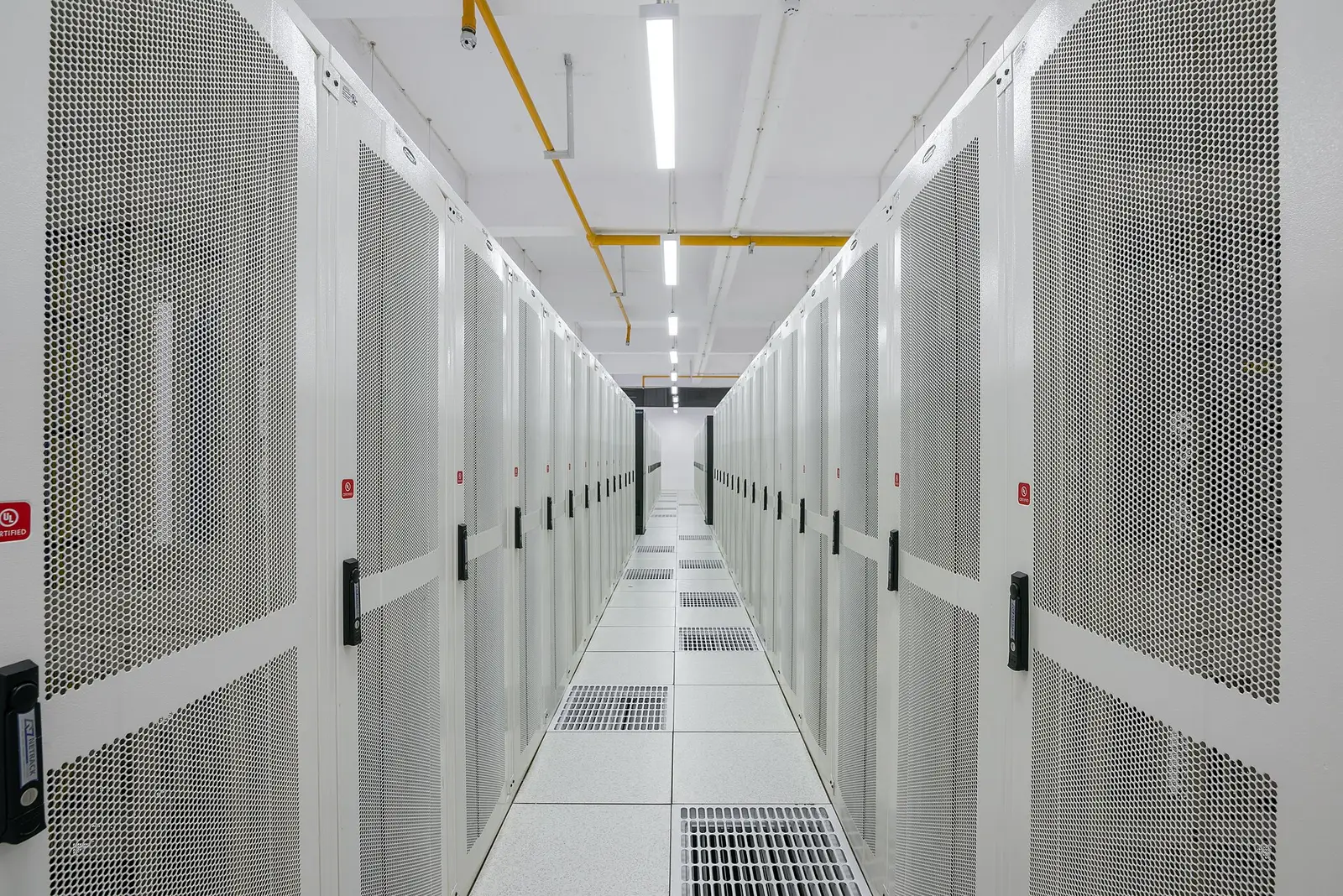

In the three months to September 2026, four American companies spent roughly $202 billion on buildings, servers and network equipment. A year earlier Microsoft alone had spent $19.4 billion in the same quarter; this year it spent $39.4 billion. The purpose, overwhelmingly, is computing capacity for artificial intelligence.
This is one of the largest private investment programmes ever undertaken. The companies’ own filings make it possible to follow the money with unusual precision, and to see what is and is not yet known.
Who is paying
The buyers are the largest cloud providers and platform companies. Their annual spending on property and equipment has grown as follows:
| Company | Two years ago | Last year | Latest year |
|---|---|---|---|
| Amazon (calendar year) | $52.7bn (2023) | $83.0bn (2024) | $131.8bn (2025) |
| Microsoft (year to June) | $44.5bn (2024) | $64.6bn (2025) | $115.9bn (2026) |
| Alphabet (calendar year) | $32.3bn (2023) | $52.5bn (2024) | $91.4bn (2025) |
| Meta (calendar year) | $27.0bn (2023) | $37.3bn (2024) | $69.7bn (2025) |
The pace is still rising. Amazon has told investors to expect about $220 billion in 2026; Meta has guided to between $135 billion and $145 billion.
Who is supplying
A large share of that spending becomes revenue for a small number of suppliers.
The most visible is NVIDIA, whose processors are the standard for training AI systems. Its data-centre revenue was $193.7 billion in its last full fiscal year and $107.6 billion in the latest quarter alone. NVIDIA designs chips but does not make them. Its annual report names TSMC and Samsung Electronics as its manufacturers and SK hynix, Micron and Samsung as suppliers of memory, with a supply chain “mainly concentrated in Asia”.
The dependence runs both ways. NVIDIA reported that two direct customers accounted for 22% and 14% of its revenue. A handful of buyers and a handful of sellers are each other’s main counterparties, which is why our explainer on the semiconductor supply chain describes it as concentrated at every stage.
Where the money comes from
Until recently these companies funded investment comfortably from their own cash. That is no longer true for all of them.
- Cash flow. In the September quarter Alphabet spent $51.4 billion on capital projects against $42.3 billion of cash from operations. Meta’s free cash flow was slightly negative. Amazon’s was minus $42.4 billion over twelve months.
- Debt. Amazon’s long-term debt rose from $65.6 billion to $173.1 billion in the first nine months of 2026; Alphabet’s from $46.5 billion to $125.1 billion.
- Off the balance sheet. Meta’s filing describes two data-centre ventures in which it holds 20% and which it does not consolidate, together with about $356 billion of leases that have not yet begun and up to $41.5 billion of guarantees on the value of the assets.
None of this is hidden; it is in the filings. But it changes the nature of the bet. Investment paid for out of profits can disappoint without consequences beyond lower returns. Investment paid for with debt and long leases creates obligations that remain if demand falls short. It also makes interest rates, which rose in 2026, a direct cost.
What could go wrong
Official bodies have started to set out the risks. The IMF’s October 2026 stability report warned that weaker AI investment or profitability could trigger a market correction amplified by leverage and concentrated exposures. The Bank of England’s Financial Policy Committee noted a sharp fall in AI-related share valuations in July and drew attention to “circular arrangements”.
Four questions matter most.
Is the demand there? None of the four companies reports revenue from AI separately, so outsiders cannot check whether sales are growing in line with investment. Microsoft discloses contracted future revenue of $677 billion, but contracts with AI developers that are themselves loss-making are only as good as those customers’ funding.
Is some of it circular? Microsoft holds roughly a quarter of OpenAI and reported $10 billion of revenue from it in one quarter. Amazon invested $50 billion in OpenAI in 2026 while expanding a supply agreement with it. When an investor, supplier and customer are the same party, growth in one line can reflect spending in another.
How long does the equipment last? Depreciation, the annual charge for wearing out equipment, depends on an assumed lifespan. Alphabet uses about six years for servers. Amazon cut the assumed life of some from six years to five in 2025. If successive chip generations make older ones uneconomic sooner, today’s profits are overstated.
Can it be powered? The US Department of Energy estimates that data centres used 4.4% of American electricity in 2023 and could use between 6.7% and 12% by 2028. The International Energy Agency reckons about a fifth of planned projects are at risk of delay because of grid connections.
A note on NVIDIA
One development is too recent to interpret. NVIDIA’s results for the quarter to October 2026 were signed by its chief financial officer as interim chief executive, and the release referred to a search for a new chief executive and to an ongoing investigation by an independent committee of its board. The company gave no further detail. For a business at the centre of this investment cycle, that is a material uncertainty, and it is recorded here as exactly that.
What to take from it
The established facts are striking enough: the spending is real, it is accelerating, and it is increasingly financed by borrowing. What cannot yet be established is whether it will pay. That depends on revenue the companies do not break out, on technology that is still changing, and on electricity that has not yet been connected. The filings due each quarter are where the answer will first appear.