
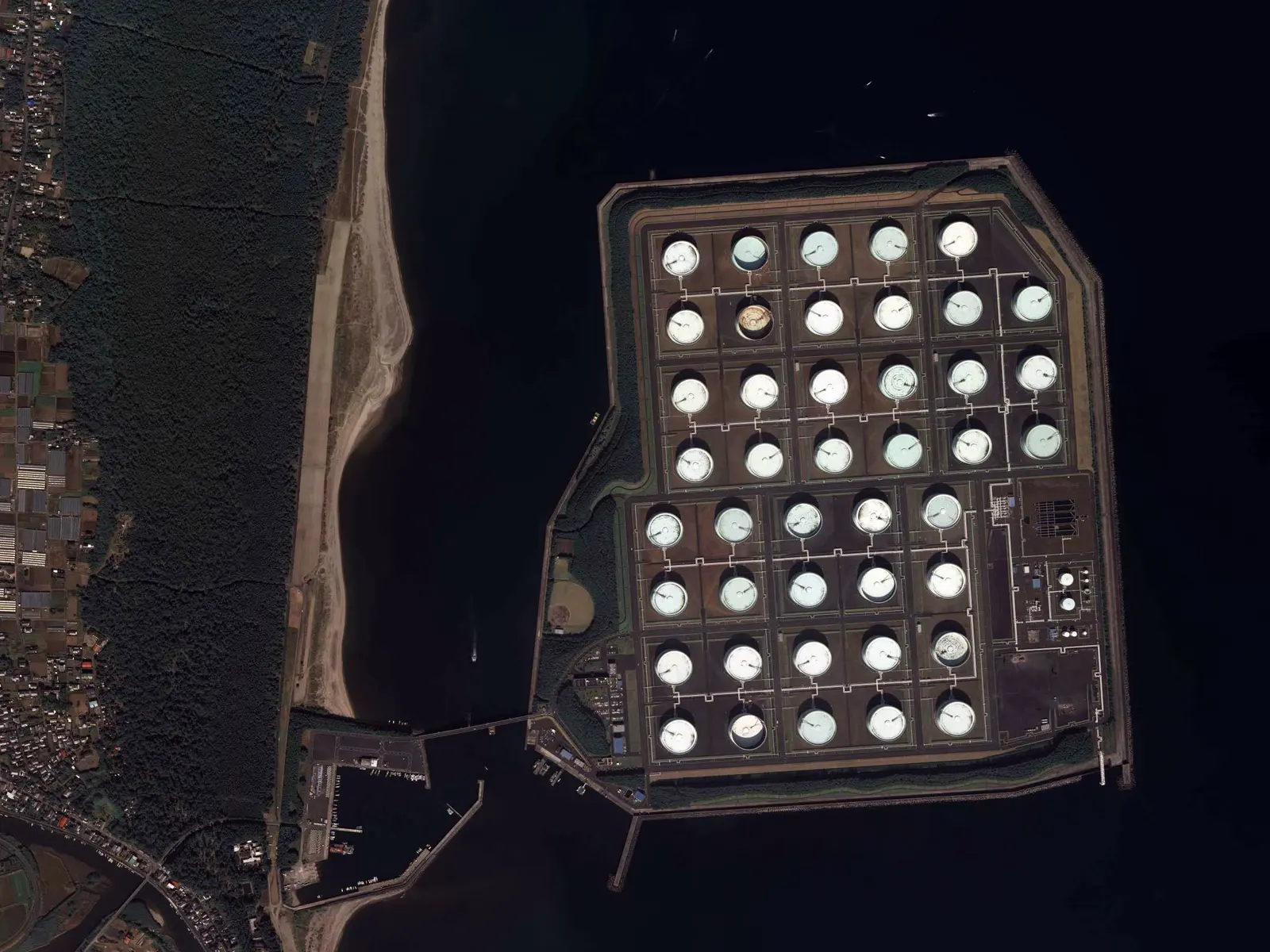

Two numbers came out of Tokyo and Riyadh this week, and they are easy to confuse. One is about space: Japan intends to lend Saudi Arabia room to store more crude oil on Japanese soil. The other is about oil: Japan may buy some Saudi crude for its own emergency reserve. They are separate steps with separate purposes, and neither has been carried out yet.
What was agreed
Saudi Arabia’s energy minister, Prince Abdulaziz bin Salman, and Japan’s trade and industry minister, Akazawa Ryosei, met online on 9 November. Japan’s Ministry of Economy, Trade and Industry (METI) published their joint statement on 20 November. It sets out two intentions:
| What it is | Size | Condition | |
|---|---|---|---|
| Storage | Japan lends Saudi Arabia tank space in its national stockpiling facilities, on a time-bound basis | 16 million barrels, on top of 8 million already in use: up to 24 million | None stated; no timeline or sites given |
| Purchase | Japan buys Saudi crude for its national stockpile | Up to 8 million barrels | Favourable market conditions and internal procedures |
The statement also says Saudi Arabia has already begun refilling the tanks it uses in Japan.
The wording deserves care. The English text says Japan “intends to lend” 16 million barrels of capacity; METI’s Japanese translation says “up to” 16 million, spread across commercial and non-commercial tanks. The purchase in the Japanese text is conditional on a competitive price. Until METI names bases and dates, treat both as plans rather than completed deals.
The scheme behind it
This builds on an arrangement that has run for more than a decade. Under Japan’s joint stockpiling scheme, the government lends oil tanks to producer countries’ national oil companies. In normal times the producers use them as a storage and supply base for customers in East Asia. In a supply crisis, according to Japan’s Agency for Natural Resources and Energy, Japanese companies get the oil first. Saudi Aramco began storing crude at the Okinawa oil terminal in February 2011; Abu Dhabi’s national oil company and Kuwait’s take part too.
Japan counts this as its third line of defence, after state-held and privately held stocks. At the end of September 2026 the three together covered 204 days of consumption: 103 days of national stocks, 95 of private stocks and 6 of joint stocks with producers.
Why now
2026 has tested both Gulf export routes and Japan’s buffers. US government estimates show oil flows through the Strait of Hormuz falling from 21.6 million barrels a day at the end of 2025 to 5.1 million in the second quarter of 2026, as our explainer on the strait describes. Japan, which imports most of its crude from the Middle East, has been releasing oil from its national and joint stocks since 26 March.
The joint statement itself does not mention Hormuz. It refers to the “effectiveness” the joint stockpiling project “recently demonstrated”, which is as close as the two governments come to saying the scheme was used in the crisis.
What each side could gain
Japan. More crude stored at home that Japanese buyers can draw on first in an emergency, and, if the purchase goes ahead, a start on rebuilding a national reserve that has been run down this year.
Saudi Arabia. Tanks close to its largest customers. Oil already sitting in East Asia can be sold into the region more flexibly, which matters more when the route out of the Gulf is uncertain. For Aramco, whose results this year have depended on how much oil it could physically export as well as on price, storage near buyers is a practical asset.
Broader markets. The episode is a reminder that oil supply depends on infrastructure (tanks, pipelines, shipping lanes) and on long-term relationships between producers and importers, not only on the daily price of Brent crude.
These are possible effects, not guaranteed outcomes. In scale, up to 24 million barrels is modest next to Japan’s total stocks of about 370 million barrels of crude and products, though it is about twice the roughly 11 million barrels Japan held jointly with all producer countries at the end of September. Its significance lies more in what it signals about how importers and producers are rethinking energy security than in any direct effect on prices. No price movement has been reported as a result of the announcement, and we do not attribute one to it.
What to watch
- Whether METI names the stockpiling bases and a timetable for the extra capacity.
- Japan’s monthly stockpile report, for signs that national reserves are being rebuilt and whether the 8-million-barrel purchase goes ahead.
- Whether other producers seek similar arrangements in Japan or elsewhere in Asia.